


News & Events
Older news and events have been posted. Read about past happenings with the Chicago I-290 project below or you can also view current news now!
2019
|
What is the current status of the I-290 project?
In June of 2017 a Final Environmental Impact Statement (FEIS) and a Record of Decision (ROD) was signed by the FHWA that identified the HOT 3+ & EXP & HCT Alternative (also referred to as Alternative HOT 3+) as the Selected Alternative. This alternative consisted of adding one High Occupancy Toll (HOT) 3+ lane (three or more occupants per vehicle required for non-tolled use, or one/two occupants per vehicle paying a toll) in each direction between 25th Avenue and Austin Boulevard; conversion of one existing general-purpose lane in each direction west of 25th Avenue and east of Austin Boulevard to HOT 3+ use; and provisions for express bus service and a high-capacity transit extension. Based on an FHWA project Cost Estimate Review in June of 2017, the construction cost of the Selected Alternative was estimated at $3.2 billion. As the proposed improvement is not currently included in Department’s FY 2021-2026 Proposed Highway Improvement Program and continues to be one of several regional expressway corridors competing for limited available state and federal funding, the Department must now consider more sustainable solutions for addressing the reconstruction needs of this facility and is continuing to evaluate financial plans and methods to deliver this improvement. If you have any questions or would like additional information, please contact Brenda Alicea, Consultant Studies Unit Head, at (847) 705-4107. |
August 2019 |
2017
|
I-290 Section 106 Effects Assessment Report is Complete
The I-290 Section 106 Effects Assessment Report has been completed to evaluate the effects of the proposed reconstruction of I-290 on historic properties. The report documents the methodology and assessment of effects to built historic properties in the I-290 Area of Potential Effects (APE) for this project. Pending final coordination/consultation with the Consulting Parties and the SHPO, the FHWA has made an effect determination of no adverse effect for the I-290 project. Any comments should be addressed to IDOT c/o Mark Peterson at mark.peterson@illinois.gov or (847) 705-4569 by Wednesday, May 3, 2017. Section 106 Effects Assessment Report |
April 2017 |
2016
|
Village of Maywood Held Town Hall Meeting #2
The Maywood Advisory Working Group (AWG), which was formed in January of 2016, has been working closely with IDOT and the study team on the proposed improvements and transportation needs of the region, as well as specific needs and concerns of Maywood residents and business owners. At the second Town Hall Meeting held on August 31, 2016 at Proviso Mathematics and Science Academy, IDOT summarized the findings and recommendations from the AWG process and discussed next steps. The meeting also provided an additional opportunity to hear about the noise wall process and provide feedback to the project team. The meeting was an open house from 6:00 PM - 8:00 PM, where attendees viewed study exhibits and maps, as well as able to speak with study team representatives. A formal presentation was given at 7:00 PM, followed by a moderated Q&A session ending at 8:00 PM. See the meeting materials here. |
August 2016 |
|
Maywood Advisory Working Group Process Wrapping Up
Preferred plan keeps all ramps open In January 2016, the Maywood Advisory Working Group (AWG) was formed, and included local residents, business owners Maywood staff, and elected officials. After eight months of discussion and analysis, a preferred plan for the section of I-290 between 25th Avenue and 1st Avenue has been identified. The identified preferred alternative keeps all existing I-290 ramps open, and includes new interchanges at 25th Avenue and 1st Avenue. At 25th Avenue, the existing loop ramps will be removed to accommodate a new Single Point Urban Interchange (SPUI) that will have all ramps connecting directly at 25th Avenue. Similar to 25th Avenue, a SPUI will also be constructed at 1st Avenue. The SPUIs include dedicated dual left turn lanes and are operated by only one signal, which will drastically reduce signal wait times and vehicle stacking. To accommodate the improved interchange design at 1st Avenue, Harrison Street and Bataan Drive will not connect to 1st Avenue, which will reduce the amount of non-local, cut-through traffic currently using these streets to avoid expressway congestion. Compared to the existing conditions, the performance benefits of the preferred alternative include: -24% Reduction in travel time between the expressway and local residential and business areas -74% reduction in signal wait times at 1st Avenue -77% reduction in vehicle stacking along 1st Avenue -5% reduction in traffic on local roads Other local benefits include: -Discourages “cut-though” or non-local frontage road traffic: 90% of existing trips using the frontage road connections at 1st Avenue are not local (link to exhibit) -Bataan Drive and Harrison Street will be fully reconstructed Additional storm sewer pipe capacity will be added to provide additional flood protection opportunities for the Village of Maywood (link to exhibit 1, exhibit 2) -Additional level green space areas will be provided between the frontage roads and the expressway (link to exhibit) -All bridges crossing I-290 will be replaced with new bridges that have 12-foot wide sidewalks (link to exhibit) -A new, protected/signalized IL Prairie Path crossing of 1st Avenue will be added (link to exhibit) -New aesthetic opportunities are available along the frontage roads and cross-street bridges. Additional information on the AWG process and findings can be found here. Due to design changes required by the Preferred Alternative, a new noise wall analysis and voting process is required. Noise wall locations have been revised and reevaluated and the voting process re-initiated residents and property owners who are benefitted by the proposed noise walls. |
August 2016 |
|
Noise Wall Re-Vote between 1st Avenue and 25th Avenue
IDOT re-issued noise wall ballots to residents and property owners located behind the proposed noise walls along I-290 between 1st Avenue and 25th Avenue. The re-vote for noise walls in this area is due to expressway design changes that occurred since the original vote last year. The design revisions were identified through the Maywood Advisory Working Group (AWG) process that directly involved local residents, business owners, Village Staff, and elected officials. Six expressway access alternatives were identified and evaluated with respect to how well they address local and regional transportation needs. The selected preferred alternative will retain all existing ramp connections between 1st Avenue and 25th Avenue. Because of the design change since the original noise wall vote, IDOT was required to reevaluate the locations and performance of the noise walls, and issue a revote. In mid-August, residents and owners of properties that were determined to be “benefitted” by a noise wall were mailed a ballot to vote in favor or against the wall. A property is considered to be benefitted if the proposed noise wall results in a perceptible reduction in noise level (five decibels or more). If more than half of the returned ballots are in favor of a wall, that wall will likely be constructed as part of the expressway reconstruction. A final decision on the installation of noise walls will be made upon completion of the project’s final design and the public involvement process prior to construction. If you have any questions regarding the location your property or residence, why your property is or is not benefitted, or if you should have received a ballot and have not, please contact Mark Peterson at mark.peterson@illinois.gov or (847)-705-4569. About the Federal Noise Wall Process: The noise wall evaluation and voting process is required by the Federal Highway Administration for an expressway reconstruction project. The decision to construct any proposed walls is made by the voters that benefit from the wall. Only property owners and renters with a noise decrease of at least 5 decibels are eligible to vote. A voter response rate of 33% is desired. If the response from the initial mailing is less than 33%, a second ballot will be mailed to the property owners and renters who did not vote in the first round. |
August 2016 |
|
Maywood Held Advisory Working Group Meeting #5
The fifth Maywood Advsiory Working Group Meeting was held on August 17, 2016 from 6-8 PM at the Maywood Multipurpose Building. The Village of Maywood, in partnership with the Illinois Department of Transportation,hosted the fifth I-290 AWG meeting to continue discussions regarding proposed Eisenhower Expressway improvements. At AWG meeting #5, which was held on August 17, 2016, IDOT presented the Alternative 6 local circulation and the noise wall re-evaluation process. View the meeting presentation here and the exhibits here. Meeting topics: - Preferred Alternative - Noise Wall Study Update - Next Steps The AWG meetings are open to the public and there will be an opportunity for audience members to ask questions following the presentation and agenda items. For more information about the AWG, please contact the Maywood Village Manager's offica at 708-450-6303. The AWG was created by the Village of Maywood, in partnership with the Illinois Department of Transportation (IDOT), to address community concerns regarding the Eisenhower Expressway improvements related to community access, safety, and traffic flow. For more information about the AWG, please contact the Maywood Village Manager’s office at 708-450-6303. Not on the mailing list? Click here to sign-up. To view the AWG Meeting #1 materials, click on the following link: presentation. To view the AWG Meeting #2 materials, click on the following links: presentation, exhibits, and traffic simulation videos. To view the AWG Meeting #3 materials, click on the following links: presentation and exhibits. |
August 2016 |
|
Village of Maywood Held Advisory Working Group Meeting #4
The Village of Maywood, in partnership with the Illinois Department of Transportation, held the fourth Advisory Working Group (AWG) meeting on June 23, 2016 to continue discussions regarding proposed Eisenhower Expressway improvements. View the meeting presentation here and the exhibits here. At AWG meeting #3, which was held on April 21, 2016, IDOT narrowed the list of alternatives to Alternatives 1 and 6, which are illustrated here. Both options retain all existing I-290 ramps, but differ in their design at the First Avenue interchange. Alternative 1 includes the current frontage road connections at First Avenue (Harrison Street, Bataan Drive), while Alternative 6 does not include these frontage road connections, as illustrated here. At the June 23rd AWG meeting, IDOT presented a recommended preferred alternative. The Project Study Group is seeking stakeholder comments through July 14, 2016. Meeting Topics: Comparison of Alternatives 1 and 6 Preliminary Preferred Alternative Recommendation Next Steps The AWG meetings are open to the public and there will be an opportunity for audience members to ask questions following the presentation and Working Group agenda items. For more information about the AWG, please contact the Maywood Village Manager’s office at 708-450-6303. To view the AWG Meeting #1 materials from January 21, 2016, click on the following link: presentation. To view the AWG Meeting #2 materials from February 25, 2016, click on the following links: presentation, exhibits, and traffic simulation videos. To view the AWG Meeting #3 materials from April 21, 2016, click on the following links: presentation and exhibits. To view the Town Hall Meeting #1 materials from May 4, 2016, click on the following links: presentation and exhibits. |
June 2016 |
|
Maywood Held Town Hall Meeting to Discuss Proposed Improvements
The Illinois Department of Transportation (IDOT) initiated the I-290 Eisenhower Expressway Study in 2009 to identify ways to improve multimodal transportation throughout the corridor. Maywood is a key stakeholder in the I-290 corridor, and IDOT’s goal is to develop a plan that addresses both transportation needs and community concerns. The purpose of the Town Hall meeting, which was held on May 4, 2016 at the Proviso Mathematics and Science Academy, Forest Park Illinois, was to present the work to date by the Maywood Advisory Working Group and IDOT, and provide additional input opportunities for the community. At this open house meeting, attendees were able to view study exhibits and maps, as well as speak one-on-one with study team representatives. A formal presentation was provided followed by a moderated Q&A session. Click on the following links to view the meeting materials: presentation, exhibits |
May 2016 |
|
Maywood Held Third Advisory Working Group Meeting
The Maywood Advisory Working Group (AWG) was created by the Village of Maywood, in partnership with the Illinois Department of Transportation (IDOT), to address community concerns regarding the Eisenhower Expressway improvements related to community access, safety, and traffic flow. The third AWG meeting was held on April 21, 2016 from 6:00 p.m. to 8:00 p.m. at the Maywood Multipurpose Building, 200 South 5th Avenue. View the meeting presentation here and the exhibits here. AWG MEETING #3 TOPICS: • Present and discuss results of alternatives analysis • Initial drainage presentation • Next steps The AWG meetings are open to the public and include an opportunity for audience members to ask questions following the presentation and Working Group agenda items. For more information about the AWG, please contact the Maywood Village Manager’s office at 708-450-6303. Not on the mailing list? Click here to sign-up. To view the AWG Meeting #1 materials, click on the following link: presentation. To view the AWG Meeting #2 materials, click on the following links: presentation, exhibits, and traffic simulation videos. To view the AWG Meeting #3 materials, click on the following links: presentation and exhibits. |
April 2016 |
|
Maywood Held Advisory Working Group Meeting #3
The AWG was created by the Village of Maywood, in partnership with the Illinois Department of Transportation (IDOT), to address community concerns regarding the Eisenhower Expressway improvements related to community access, safety, and traffic flow. The third AWG meeting was held on April 21, 2016 from 6:00 p.m. to 8:00 p.m. at the Maywood Multipurpose Building, 200 South 5th Avenue. View the meeting presentation here and the exhibits here. AWG MEETING #3 TOPICS: • Present and discuss results of alternatives analysis • Initial drainage presentation • Next steps The AWG meetings are open to the public and include an opportunity for audience members to ask questions following the presentation and Working Group agenda items. For more information about the AWG, please contact the Maywood Village Manager’s office at 708-450-6303. Not on the mailing list? Click here to sign-up. To view the AWG Meeting #1 materials, click on the following link: presentation. To view the AWG Meeting #2 materials, click on the following links: presentation, exhibits, and traffic simulation videos. To view the AWG Meeting #3 materials, click on the following links: presentation and exhibits. |
March 2016 |
|
I-290 Expressway Access Improvement Studies between 1st And 25th Avenues
Based upon concerns raised by Maywood residents and elected officials, an Advisory Working Group (AWG) was formed in January 2016. The goal of the AWG process is to build consensus for an overall expressway and interchange access alternative that improves community access, safety, and traffic flow. The findings of the Maywood AWG process will also be coordinated with the Villages of Bellwood and Broadview. The AWG is comprised of Village officials as well as community leaders, businesses, and residents. The group is supported by IDOT staff and consultants. There have been three meetings since January 2016. The third meeting was held on April 21, 2016 from 6:00 p.m. to 8:00 p.m. at the Maywood Multipurpose Building, 200 South 5th Avenue. In addition to the AWG meetings, Maywood (in conjunction with IDOT) will host Town Hall meetings in the spring and summer of 2016. These meetings will present the work to date by the AWG and IDOT, and provide additional input opportunities for the community. The first Maywood Town Hall Meeting will be held on Wednesday, May 4, 2016 from 6:00 p.m. to 8:30 p.m. at the Proviso Mathematics and Science Academy, 8601 West Roosevelt Road, Forest Park, Illinois. Not on the mailing list? Click here to sign-up. To view the AWG Meeting #1 materials, click on the following link: presentation. To view the AWG Meeting #2 materials, click on the following links: presentation, exhibits, and traffic simulation videos. To view the AWG Meeting #3 materials, click on the following links: presentation and exhibits. 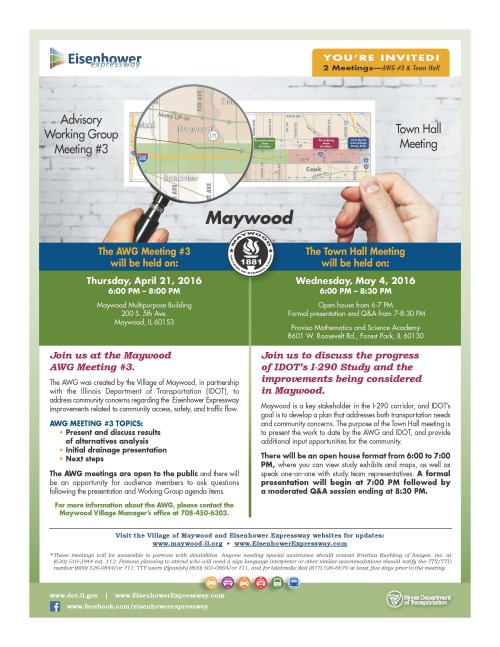 |
March 2016 |
|
Village of Maywood Held Second Advisory Working Group Meeting
The second Maywood Advisory Working Group (AWG) meeting was held on February 25, 2016 to discuss I-290 improvements. View the presentation and exhibits here. Traffic simulation videos from the meeting can be viewed here. The AWG was created by the Village of Maywood, in partnership with the Illinois Department of Transportation (IDOT), to provide more opportunities for stakeholders to participate in the ongoing I-290 Study. At the first AWG meeting, IDOT and stakeholders discussed community concerns and an overall process for addressing those concerns. Through a series of monthly workshops, IDOT will work with stakeholders to develop a consensus plan that considers safety, mobility, community and environmental factors. The AWG discussed the following topics at the second meeting: • Overview of existing conditions (safety, traffic and access) • Alternatives scoping • Noise wall vote results • Next steps The AWG meetings are open to the general public and include an opportunity for audience members to ask questions following the presentation and Working Group agenda items. For more information about the AWG, please contact the Maywood Village Manager’s office at 708-450-6303. 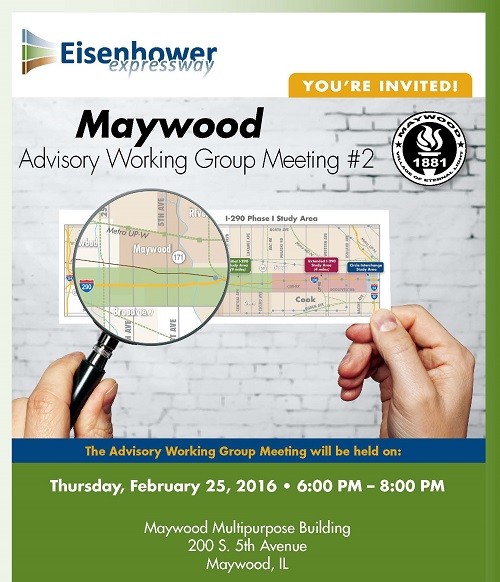 |
February 2016 |
|
What to Know About the I-290 Noise Wall Process
Where are we now? In the fall of 2015, IDOT completed a traffic noise analysis for the project. The analysis concluded that certain areas along the expressway could benefit from a noise wall. IDOT hosted or participated in informational forums for property owners and occupants in October, November and December of 2015. View the presentation, exhibits, and noise wall simulation video presented at the forums. In November, IDOT initiated the noise wall voting process, which is anticipated to be completed by the end of February 2016. How does the noise wall voting process work? As established by Federal Highway Administration regulations, property owners are able to vote for or against noise walls in their area. In order for a person to be eligible to vote, the noise wall must decrease the noise level at the property by at least 5 decibels, which is a readily perceptible change in noise (typically homes within 300 feet of a noise wall). Anything less than 5 decibels is barely detectible by the human ear, therefore a noise wall would not provide any perceptible benefit. For more information about how the noise analysis was conducted, view the traffic noise analysis report. IDOT has identified all of the properties that could benefit from noise walls and has notified those residents and property owners of their voting eligibility. A map depicting these properties can be found here. If more than 50% of the votes received are in favor of a wall, a wall will likely be included in the project. A response rate of at least 33% of eligible voters is desired. If the response rate from the initial ballot mailing is less than 33%, a second ballot will be mailed for residents in those areas only to the residents and property owners who did not vote in the first round. Voters who are in the “first row” of receptors (who share a property line with the highway) will be counted and weighed as two votes. All others will be single votes. For rental properties, each occupant will count as one vote and the owner counts as one vote per unit. A final decision on the installation of abatement measures will be made upon completion of the project’s final design and the public involvement process. Who pays for the noise walls to be constructed? If the benefitted receptors* vote in favor of a noise wall, the standard construction cost will be borne by IDOT as part of the overall I-290 project. Non-standard features, or enhanced aesthetics, will be subject to municipal cost participation. Individual property owners would not be asked to pay for a noise wall. *Benefitted receptors are residents and property owners who benefit from a noise wall. Who pays for maintenance? IDOT will be responsible for maintaining the structural integrity of the wall, and the appearance of the “expressway” side of the wall (i.e., graffiti removal). Each local municipality would be asked to maintain the appearance of the “community” side of the wall, in addition to any non-standard or enhanced features. Questions? Visit our FAQ page or you can submit your questions and comments using our online form, or send comments to: Illinois Department of Transportation-Region One/District 1 Attn: Mark Peterson 201 W. Center Court Schaumburg, Illinois 60196 Or call Mark Peterson at 847.705.4569. Before & After: Noise Wall Slideshow
View a before and after noise wall slideshow. Before & After: Noise Level Simulation Video Listen to a before and after noise level simulation. |
January 2016 |
|
IDOT Holds Forums Regarding Noise Wall Process
As part of the ongoing I-290 study, the Illinois Department of Transportation hosted public forums on October 27, 28, and 29, 2015 to inform residents about the noise wall voting process, which is taking place in conjunction with the planned improvements on the Eisenhower Expressway. IDOT provided a short presentation on the planning process, as well as results of the noise analysis, to help property owners and tenants make an informed decision on the potential noise walls. The forums were held in advance of the voting process, to inform property owners, residents and the broader community about the noise wall process and eligibility requirements. View the I-290 noise wall forum presentation. To provide more opportunities for residents to learn about the noise wall process, the Village of Oak Park held an open-house meeting on November 5, 2015, where residents were able to talk with Village officials and IDOT representatives. On November 9, 2015, IDOT presented project updates at the Village of Forest Park board meeting, which was also open to the public. In addition, the Village of Maywood held a public meeting on December 7, 2015, in coordination with IDOT, to provide residents with more information regarding the proposed I-290 reconstruction as well as the noise wall process. |
January 2016 |
|
Study Area Highlights: Harlem Avenue Interchange Reconstruction
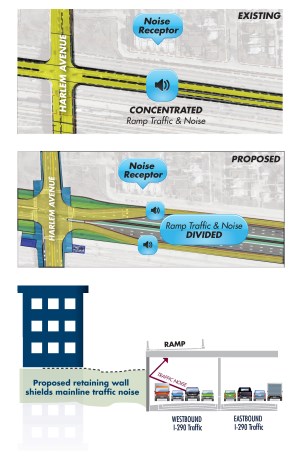
As documented as part of the I-290 planning process, there are many safety, mobility, condition and design concerns related to left-hand ramps. The Study Team needed to address these multiple concerns as well as community concerns about the height and location of the ramps. The proposed interchange design has been guided by these factors, and although the ramps connect to I-290 on the right side, the intersection remains centered over the expressway, while also covering a portion of I-290. The following highlights the key features at the Harlem Avenue interchange. Interchange Concept Addresses Deficiencies; Minimizes Footprint I-290 will be shifted as much as 18 feet to the south, increasing the distance between the expressway and businesses and residences on Harrison and Lehmer Streets. The mainline will also be lowered by up to seven feet, with over 300 feet of expressway entirely covered by the reconfigured ramps. The lowering of the expressway allows for the proposed ramps to remain the same height or lower than the existing ramps. Right-Hand Ramps Offer Noise Reduction Benefits to Community A noise sensitivity test was performed to compare the effects of shifting the left-hand ramps to right-hand ramps. The test compared the effects of various design changes (location, alignment, heights and grades) using existing traffic. The study found that the proposed right-hand ramp design acts as a barrier to mainline expressway noise, which is the primary generator of traffic noise at this location. Also, the ramp traffic will be divided, pushing the higher volume, eastbound on-ramp traffic further south, away from Harrison Street. These two features, as well as less steep grades, actually reduce noise levels, as compared to the existing left-side design. Further studies and coordination with the community will determine if there are noise impacts that require mitigation. (See Exhibit A) Enhanced Transit Access The I-290 Study Team has been working closely with both CTA and Pace on enhancing transit access and connectivity. Wider sidewalks in front of the existing CTA station are proposed, as well as a southbound bus pullout in front of the station. In the northbound direction, a bus stop is provided directly across from the station, with a well-marked and signalized pedestrian crossing. Improved Capacity/Operations The proposed interchange design will substantially improve capacity and operations. With upgraded geometry and modern traffic signals, delay to motorists would be reduced by up to 80%, and vehicle stacking by up to 55%. At the same time, the proposed design will provide safer options for pedestrians. Bike and Pedestrian Improvements The new interchange designs accommodate several bike and pedestrian amenities, including: - Wider sidewalks - Sidewalks and ramps compliant with the Americans with Disabilities Act (ADA) - Improved pedestrian crossings and signals - Pedestrian refuge islands between ramps - Large pedestrian plaza areas in each corner of the intersection - An east-west shared-use path accommodation under Harlem Avenue  |
January 2016 |
|
Village of Maywood Holds First Advisory Working Group Meeting
The first Advisory Working Group Meeting was held on Thursday, January 21, 2016. View the meeting materials here. The Village of Maywood formed an I-290 Advisory Working Group (AWG) to work with the Illinois Department of Transportation (IDOT) to discuss the ongoing I-290 study in more detail. The group is comprised of Village officials and community leaders, and supported by IDOT staff and consultants. The AWG is anticipated to meet monthly through late spring 2016. The meetings are open to the general public and will include an opportunity for audience members to ask questions following the presentation and AWG agenda items. For more information about the AWG, please contact the Maywood Village Manager’s office at 708-450-6303.  |
January 2016 |
2015
|
Oak Park Traffic and Interchange Simulation Videos
The following videos include traffic and interchange simulations along I-290 within the Village of Oak Park. These videos were presented at Oak Park Working Group meetings and Village Board meetings between spring 2015 and winter 2015. These concepts are considered preliminary and subject to further evaluation and refinement as detailed design continues and additional stakeholder input is received. If you have any comments, questions, or concerns regarding the concepts, we encourage you to submit them to the study team for consideration. For more simulation videos, visit our |
November 2015 |
|
Village of Maywood Hosts Eisenhower Town Hall Meeting
The Village of Maywood hosted a Town Hall Meeting on January 29, 2015 at the Proviso Mathematics and Science Academy to discuss proposed I-290 improvements and potential impacts on Maywood. The Illinois Department of Transportation (IDOT) initiated the I-290 Eisenhower Expressway Study in 2009 to identify ways to improve multimodal transportation from the I-88 and I-290 split on the west to Racine Avenue on the east. With input throughout the process from agencies, local communities and the public, there are four remaining alternatives. Each of these alternatives includes improvements to all modes of travel, including bicycle, pedestrian, bus and rail transit, and vehicle. Attendees learned about:
|
February 2015 |

2014
|
The Eisenhower Expressway Corridor Advisory Group and Task Force Meeting #19
CAG #19 is a continuation of the Round 3 evaluation, and is a critical part of the planning process. The objective of Round 3 is to move from the four remaining conceptual alternatives to a detailed preferred alternative by early 2015. We look forward to working with stakeholders to achieve that objective. Meeting topics include: • CAG #18 recap • Round 3 Evaluation - Continued • Environmental Impact Statement Overview • Drainage: Existing Drainage Plan and Overview Process • Next Steps September 24, 2014 The Carleton Hotel of Oak Park 1110 Pleasant Street Oak Park, Illinois 60302 9:00 AM - 11:00 AM |
September 2014 |
|
What are the Round 3 Findings to Date?
In addition to the development of geometry, more detailed engineering and environmental studies are underway to support the evaluation of the remaining alternatives. The findings from our technical studies will be presented over a series of CAG meetings. Drainage – the existing drainage system, which was constructed in the 1950’s, was designed to accommodate a 10-year storm, but has endured much more, and is therefore deteriorating. This has resulted in an increasing number of road closures due to flooding. A proposed drainage system is being developed to handle larger, 100-year storms, which will reduce flooding and lane closures. Discussions are beginning this fall with adjoining communities and other stakeholders to develop and finalize a proposed drainage design. Other areas to be studied in Round 3 include social and economic impacts, as well as air quality and noise. Updates will be provided on the project website and in future newsletters.  Enlarged View |
September 2014 |
|
The Eisenhower Expressway Corridor Advisory Group and Task Force Meeting #18.
CAG #18 represents the beginning of the round #3 evaluation, and is a critical part of the planning process. The objective of round #3 is to move from the four remaining conceptual alternatives to a detailed preferred alternative by early 2015. We look forward to working with stakeholders to achieve that objective. Wednesday, July 30, 2014 The Carleton Hotel of Oak Park 1110 Pleasant Street Oak Park, Illinois 60302 9:00 AM - 11:00 AM |
July 2014 |
|
State Senator Lightford Hosts Eisenhower Town Hall Meeting
Illinois State Senator Kimberly A. Lightford (D-4th) will provide a Public Forum for the Eisenhower Expressway at a Town Hall Meeting on Tuesday, April 22, 7:00 - 8:30 pm at Proviso Math and Science Academy in Forest Park. IDOT has completed three rounds of alternatives evaluations and a set of Public Meetings that were held in October 2013, to present analyses completed to date, and the next steps in the planning process. There is still time for the community to provide input on the alternatives, and Senator Lightford is providing an opportunity for the public to hear from experts about the project, as well as ask questions and look at the latest alternatives. IDOT is considering additional evaluation measures, including travel benefits, environmental effects, and costs. The Round 3 alternatives will be carried into the Draft EIS and presented at a Public Hearing in late 2014 or early 2015. After the Public Hearing, a preferred alternative will be selected on the basis of technical studies and stakeholder input, and a Final EIS will be prepared to complete the planning process. Senator Lightford will be joined by IDOT representatives, CTA staff, Citizens for Appropriate Transportation, unions and the Illinois Road and Transportation Builders Association, to answer questions about the project. Proviso Math and Science Academy is located at 8601 W. Roosevelt Road in Forest Park. If you have any questions about the event, you can call Senator Lightford's office at 708-343-7444. |
April 2014 |
2013
|
CTA Blue Line Vision Study Update
In 2013, the Chicago Transit Authority (CTA) initiated the “Blue Line Vision Study,” in collaboration with the I-290 study, to identify the near- and long-term improvement goals for the Forest Park branch of the CTA Blue Line. CTA’s Vision Study evaluated infrastructure and service improvements throughout the corridor, and is coordinating these findings with the Eisenhower Expressway Study Team for incorporation into the overall I-290 corridor plan. In addition, IDOT is working with CTA and Pace on options for a cost-effective and efficient transit extension, such as express bus service to Mannheim Road.  View PDF version The Blue Line Vision Study started with an analysis of existing conditions and concluded that the tracks and stations are nearing the end of their useful life and need to be brought up to 21st century standards in terms of service, mobility and passenger facilities. The CTA has identified the following overall recommendations associated with a complete reconstruction and modernization for the Forest Park branch: - Maintain existing station entrance locations - Improve customer experience at stations - Improve infrastructure and speed - A new Forest Park terminal, yard and shop at Des Plaines Avenue - Maintain existing service - Work with IDOT on corridor improvements The study was completed in 2014, but the CTA will continue to evaluate and coordinate funding options and project phasing with IDOT, and will formally present the results in conjunction with the I-290 Public Hearing in 2016. |
September 2013 |
|
Four Alternatives Advancing
After presenting the results of our Round 2 alternatives evaluation in the spring of 2012, the project team added two additional alternatives based upon stakeholder comments, and restarted the analysis. These alternatives were tested based upon their ability to address the transportation needs identified in the I-290 Corridor, which include:
The key features of these four alternatives also include:
 Enlarged View |
September 2013 |
|
IDOT and CTA team up to enhance transit planning in the I-290 Corridor
IDOT and CTA have combined resources to enhance the I-290 transit planning process. In February of this year, the CTA initiated a Vision Study to determine a long-term planning strategy for the Blue Line Forest Park Branch. The study focuses on the Blue Line Forest Park Branch from Clinton station to Forest Park station. The CTA will continue to work with IDOT regarding potential expansion alternatives that would continue west to Mannheim Road. The Blue Line Vision study area boundaries extend from Canal Street on the east to Forest Park on the west, and between Madison Street on the north to Roosevelt Road on the south. The CTAs study will involve the assessment of transit and highway integrated enhancements, regional mobility issues, and the identification of funding sources and future collaboration opportunities. Concepts for all stations in the study area will include, but not be limited to, station access, redesign opportunities, and right-of-way (ROW) needs at specific stations along the corridor. The study will explore innovative solutions that integrate highway and transit elements to improve and maximize transportation operations in this important regional corridor. The study is expected to be completed by early 2014. |
September 2013 |
|
Austin Boulevard Concept
While the interchanges at Harlem Avenue and Austin Boulevard would have right side ramps for a portion of their length, they would transition to the center, allowing the lanes to remain within the current ramp locations. The Austin Boulevard Concept rendering is based on community feedback and IDOTs obligation as a transportation agency to meet standards of reconstruction. It is not the final design. 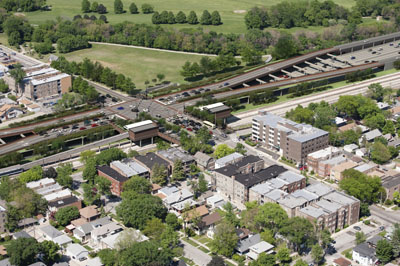 Enlarged View |
September 2013 |
|
Project Concepts Developed
During the spring of 2012, the Illinois Department of Transportation (IDOT) began presenting initial interchange concepts to community representatives within the I-290 study area. The goal of these meetings was to obtain early feedback on preliminary interchange concepts, which were also presented to the Corridor Advisory Group on June 11th. The content in the videos are conceptual and does not represent a final or detailed interchange design. The Corridor Advisory Group and Task Force consist of community and regional transit representatives, along with others who have technical expertise in transportation, engineering, land use and environmental topics. At this point in time, interchange concepts are not developed in detail; rather, IDOT is seeking input during early, conceptual stages. Moving forward, interchange concepts will undergo further refinement, technical evaluations, and incorporate stakeholder input. IDOT has been seeking stakeholder input early and often throughout the I-290 study process to ensure that all stakeholders have the ability to provide feedback as concepts are developed and evaluated. In the evaluation of alternatives and interchange concepts, it is IDOT's objective to address safety, mobility, community and environmental concerns, as well as the condition/design of the road/bridges. Currently, only funding for Preliminary Engineering and Environmental Studies (Phase I) is available. Phase I is anticipated to be completed in 2014. |
August 2013 |
|
Why are left side ramps a safety concern?
At the beginning of the I-290 planning process, we conducted a detailed review of crashes along the I-290 corridor. The two highest concentrations of crashes in the westbound direction occur in the sections of I-290 near Austin Boulevard and Harlem Avenue. The section of westbound I-290, from Laramie Avenue to Austin Boulevard, had the highest crash rate (537 crashes per mile) within the project limits, the next closest rate was on eastbound I-290 from Ashland Avenue to Racine Avenue, at 390 crashes per mile. 74% of the crashes that had an identified lane position in the police reports were in the inner two lanes at Austin, and 47% of the crashes that had an identified lane position in the police reports were in the inside lane at Harlem. This crash experience can be attributed to the inside lanes on an expressway typically serving higher speed, longer distance travel; the inside ramps introduce merging and speed changes. A national study sponsored by the American Association of State Highway and Transportation Officials (AASHTO) in cooperation with the FHWA documents that left side entrances or exit ramps have up to 180% more crashes than right side entrance or exit ramps. |
August 2013 |
|
Study Area Extended
When the I-290 study began in the fall of 2009, the study area focused on the section of I-290 from Mannheim Road to Cicero Avenue. As the alternatives evaluation process advanced into round 2, there was a need to extend the study 4 miles eastward to Racine Avenue. This new study boundary matches the improvement limits of the round 2 alternatives, and matches the study limits of the ongoing Circle Interchange study. Data regarding existing safety, mobility and facility condition was collected and analyzed. In general, the transportation needs are relatively less severe in this 4 mile eastern section, compared to the western 9 miles. 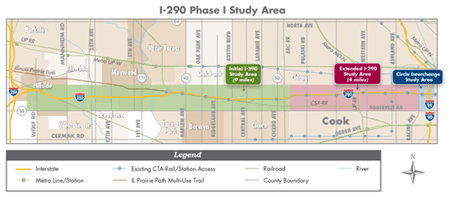 View larger |
August 2013 |
|
CTA Announces Blue Line Vision Study in coordination with the I-290 Study
The Chicago Transit Authority (CTA) has recently initiated the Blue Line Forest Park Branch Feasibility/Vision Study. The study is being undertaken to determine a long-term planning strategy for the Blue Line Forest Park Branch, with study limits including the entire Blue Line Forest Park Branch from Clinton station to Forest Park station, and potential expansion alternatives that would continue to Mannheim Road. The study area street boundaries extend from a block east of Clinton station at Canal Street on the east to Mannheim Road on the west, and between Madison Street on the north to Roosevelt Road on the south. It in anticipated that the Forest Park Branch Feasibility/Vision Study will be prepared and completed in 2013. The work will be conducted in coordination with alternatives prepared for two ongoing IDOT studies, including the I-290 Environmental Impact Statement (EIS) and the Circle Interchange Rehabilitation Project. The CTA’s study will involve the assessment of transit and highway integrated enhancements, regional mobility issues, and the identification of funding sources and future collaboration opportunities. Concepts for all stations in the study area will include, but not be limited to, station access, redesign opportunities, and right-of-way (ROW) needs at specific stations along the corridor. The study will explore innovative solutions that preserve transit, but also integrate highway and transit operations to maximize mobility in this important regional corridor. |
May 2013 |
2012
|
IDOT Presents Preliminary Interchange Concepts to Communities
During the spring, the Illinois Department of Transportation (IDOT) began presenting initial interchange concepts to community representatives within the I-290 study area. The goal of these meetings was to obtain early feedback on preliminary interchange concepts, which were also presented to the Corridor Advisory Group on June 11th. The Corridor Advisory Group and Task Force consists of community and regional transit representatives, along with others who have technical expertise in transportation, engineering, land use and environmental topics. At this point in time, interchange concepts are not developed in detail; rather, IDOT is seeking input during early, conceptual stages. More detailed studies will occur over the next several months as additional feedback is received and technical studies are completed. IDOT has been seeking stakeholder input early and often throughout the I-290 study process to ensure that all stakeholders have the ability to provide feedback as concepts are developed and evaluated. In the evaluation of alternatives and interchange configurations, it is IDOT’s objective to address safety, mobility, community and environmental concerns, as well as the condition/design of the road/bridges. Currently, only funding for Preliminary Engineering and Environmental Studies (Phase I) is available. Phase I is anticipated to be completed by the Spring of 2014. |
June 2012 |
2011
|
Additional Stakeholder Input Sought for Purpose and Need
Upon obtaining public input on the first draft of the project Purpose and Need in the Spring of 2011, the Illinois Department of Transportation released a refined Purpose and Need document dated September 2011. The release of this document initiates a new review period allowing stakeholders an opportunity to provide additional comments on the document. The review and comment period is 30 days in length and all comments received during this time period will be incorporated into the public record for the I-290 Environmental Impact Statement. A Purpose and Need is a concise statement of the transportation problems to be addressed. It contains a purpose sentence, reflecting the desired outcome of the project, and a description of the project needs. For the I-290 Study, the purpose of the project is to provide an improved transportation facility along the I-290 Eisenhower expressway multi-modal corridor. The five specific needs identified for the project include: improve regional and local travel, improve access to employment, improve safety for all users, improve modal connections and opportunities, and improve facility deficiencies. The full purpose and need document started as a July 2010 outline that was further developed, discussed and detailed resulting in the Spring 2011 version of the purpose and need. The transportation problems or needs identified in the document were determined based on a combination of stakeholder input and detailed technical studies. The technical studies focused on an assessment of the existing transportation system to identify transportation needs that exist today, and those that are anticipated to exist in the future should no major improvements occur in the study area. Each transportation mode in the corridor was reviewed and documented as well, including the highway and arterials, commuter rail (Metra), CTA heavy rail transit, CTA and PACE bus service, and freight rail systems and facilities. The results of these studies, combined with stakeholder input, influenced the development of the Purpose and Need. Each of these need points is broken down into more detail as follows:
Please click here to view the September 2011 draft of the refined Purpose and Need. Additional comments on the refined Purpose and Need are due by midnight on November 30, 2011. |
October 2011 |
|
Over 200 Stakeholders Attend Second Public Meeting
The Illinois Department of Transportation (IDOT) held the second public meeting for the Eisenhower Study on May 18, 2011 at the Proviso Math and Science Academy in Forest Park, Illinois. The meeting was an open house format, and featured a continuous PowerPoint presentation and exhibit boards. The purpose of this public meeting was to obtain public input on the Purpose and Need and initial project alternatives. Stakeholder input will continue to be considered as the planning process moves forward. IDOT has been gathering public input and presenting technical analysis through a series of nine Corridor Advisory Group (CAG)/Task Force (TF) meetings involving elected officials, community representatives, agencies and other interested stakeholders. Thus far, IDOT and stakeholders have identified the existing and future transportation needs and deficiencies in the study area for all modes of travel, including rail, bus, auto and bike/pedestrians. The results of the need analysis, in combination with stakeholder input, lead to the development of the project Purpose and Need. The following five need points summarize the project Purpose and Need: improve regional and local travel, improve access to employment, improve safety for all users, improve modal connections and opportunities, and improve facility deficiencies. By identifying the transportation problems to be addressed, the project Purpose and Need serves as a basis for evaluation of proposed project alternatives as the study progresses. In addition to the Purpose and Need, an initial list of potential solutions was on display at the public meeting. Approximately 170 alternatives have been submitted by stakeholders over the course of the study including at Public Meeting #1 and the CAG/TF alternatives workshop. The alternatives were divided by mode for easier viewing and included: Heavy Rail Transit (HRT); Bus Rapid Transit (BRT); Commuter Rail; Automated Guideway Transit (AGT); Local and Express Bus; Expressway Improvements; Managed Lanes (HOV and Tolling); Arterial Improvements; Traffic Management; Bicycle and Pedestrian Improvements; and, other alternatives. Stakeholders were encouraged to comment on the displayed alternatives or suggest additional alternatives or enhancements for consideration. An Environmental Inventory Map of the study area was also available for viewing and comment. The purpose of this map was to assist IDOT in the identification of environmental features within the study area that must be considered during the evaluation of alternatives and for identification of potential impacts. Impacts to the identified environmental features will be avoided wherever possible. Approximately 150 comment forms, suggested transportation alternatives, and website comments were submitted. Stakeholders comments included: the importance of addressing regional transportation; the desire to consider multi-modal alternatives to improve both vehicular and transit travel; improving highway access and safety; expanding transit options; improving bicycle and pedestrian access and circulation in the study area; and, positive feedback regarding the study process. Stakeholder input will also influence the development and evaluation of potential alternatives in the next steps. Stakeholders are encouraged to continue to get involved in the Eisenhower Expressway Study by regularly visiting the project website, attending public meetings, and providing comments and feedback. |
August 2011 |
|
IDOT Seeks Input on Draft Purpose and Need and Project Alternatives at Public Meeting
The Illinois Department of Transportation (IDOT) initiated the I-290 Eisenhower Expressway planning process in the Fall of 2009, and is now hosting its second Open House Public Meeting for the project. IDOT has been gathering public input and presenting technical analysis through a series of nine Corridor Advisory Group meetings involving elected officials, community representatives, agencies, and other interested stakeholders. Thus far, IDOT and stakeholders have identified the transportation needs in the study area for all modes of travel including rail, bus, auto, and bike/pedestrian. This extensive analysis and coordination effort is summarized by the following need statements: improve regional and local travel, improve access to employment, improve safety for all users, improve modal connections and opportunities, and improve facility deficiencies. These needs will provide a basis for evaluation of proposed alternatives as the study progresses. In addition, an initial list of potential solutions has been submitted by stakeholders. IDOT is seeking further stakeholder input on the identified needs as well as the initial list of alternatives, and will consider this input as the planning process moves forward. The Open House Public Meeting Will Be Held: Wednesday, May 18, 2011 4:00 – 8:00 pm Proviso Math and Science Academy 8601 Roosevelt Road Forest Park, Illinois 60130 The I-290 Open House Public Meeting will be accessible by transit. Pace bus routes 301 and 308 depart from the CTA Forest Park Blue Line station and stop at the Roosevelt Road/1st Avenue stop. Other suggested transit routes can be found at www.pacebus.com or www.transitchicago.com. |
April 2011 |
2010
|
I-290 RESURFACING PROJECT- SEPARATE FROM THIS I-290 PLANNING STUDY
The Resurfacing Project that began at Illinois Route 53 on the west to the Circle Interchange on the east was completed in Fall 2010. This project included resurfacing and bridge repairs along a 27 miles stretch of I-290. To learn more about the I-290 Resurfacing Project or to ask questions, please visit www.dot.state.il.us/I290/index.html |
April 2010 |
2009
|
IDOT Seeks Input on Transportation Issues at Public Meeting
The Illinois Department of Transportation (IDOT) has initiated a Preliminary Engineering and Environmental Study (Phase I). This study is taking an in-depth look at current and future transportation needs along the I-290 corridor through an extensive public involvement process. The study extends from west of Mannheim Road (US 12/20/45) to east of Cicero Avenue (IL Route 50). A public meeting was held Wednesday, November 18, 2009 from 4:00-8:00 p.m. at the Best Western Chicago Hillside, 4400 North Frontage Road, Hillside, IL 60162. View a presentation from the November 18, public meeting. |
December 2009 |
|
Stakeholder Involvement Plan (SIP) is Developed
The purpose of the SIP is to provide a guide for implementing stakeholder involvement for the I-290. The SIP will be used as a blueprint for defining methods and tools to educate and engage all stakeholders in the decision-making process for this project. The SIP has been designed to ensure that stakeholders are provided a number of opportunities to be informed and engaged as the project progresses. The goal of the SIP is to actively seek the participation of communities, agencies, individual interest groups, and the general public throughout the project development process. The SIP provides the framework for achieving consensus and communicating the decision-making process between the general public, public agencies, and governmental officials to identify transportation solutions for the project. The SIP:
|
June 2009 |
|
Corridor Advisory Group and Task Forces will Influence Decisions
Interaction with potentially affected communities is important for ensuring that IDOT proposals are consistent with community goals and objectives. To provide a forum for discussions of details about the goals, objectives, potential improvements, and design of I-290, IDOT is forming a Corridor Advisory Group (CAG) and Task Forces (TF). The CAG will consist of elected officials from two counties and eight municipalities. These include Cook and DuPage Counties, and the municipalities of Bellwood, Broadview, Chicago, Forest Park, Hillside, Maywood, Oak Park, and Westchester. Corridor Advisory Group To assist in the development of the environmental and engineering studies for the I-290 study, IDOT is forming a Corridor Advisory Group (CAG). The purpose of the CAG is to provide input on various study elements including defining needs and alternative development and evaluation criteria. The CAG consists of community leaders from each of the eight communities in the study area and representatives from Cook and DuPage Counties The responsibilities of this group include providing input to the study process, and reaching a consensus at key project milestones, e.g. project Purpose and Need, range of alternatives to be advanced for detailed study, and the recommended alternative(s). Task Forces A Task Force (TF) group provides a means for obtaining technical support to the CAG from a diverse set of stakeholders. The two TF categories (Transportation/Engineering and Land Use/Environmental) intend to focus on technical aspects of the project development, and provide external information and input with respect to transportation, engineering, land use and environmental topics. Task Force Groups will be formed as needed, and be comprised of stakeholders with expertise in these categories. The TF members may include CAG members or designated staff, or representatives from other governmental bodies, transportation agencies, or interest groups. The TF's will meet throughout the project development process and their input will be shared with the CAG. The TF's will focus on understanding and resolving more specific technical issues as they arise and report back to the Project Study Group (PSG). The TF's may be asked to address the CAG to help communicate technical subject matter issues. To keep staffing requirements manageable, TF's would be organized and focused on a particular topic to limit the number of study specialists needed to attend. The meeting program will be designed to encourage timely and meaningful opportunities for input into the project process. To assure proper balance with safety, mobility, and cost, IDOT and FHWA will ultimately determine the direction. |
June 2009 |
|
IDOT Takes a Fresh Look
The Illinois Department of Transportation (IDOT) is re-initiating the Eisenhower Expressway Phase I Planning and Environmental Study. This study will take a fresh look at transportation needs through an extensive public involvement process. The study is located along I-290 in Cook County extending approximately seven miles from Mannheim Road (US Route 12/20/45) to Cicero Avenue (IL Route 50) and traverses eight communities: Bellwood, Broadview, Chicago, Forest Park, Hillside, Maywood, Oak Park and Westchester. Stakeholder involvement is critical to the project success. A Stakeholder Involvement Plan (SIP) has been developed and outlines many opportunities for the public to provide input. IDOT understands that other independent studies within the study area have shared interests with the I-290 project. IDOT will continue to reach out and coordinate with these stakeholders groups throughout the study process. Currently, funding for this Phase I (Planning and Environmental Studies) is available. However, no funding is currently programmed for final design, and land acquisition (Phase II), or construction (Phase III). |
June 2009 |