


Study Status
In June of 2017 a Final Environmental Impact Statement (FEIS) and a Record of Decision (ROD) was signed by the FHWA that identified the HOT 3+ & EXP & HCT Alternative (also referred to as Alternative HOT 3+) as the Selected Alternative. This alternative consisted of adding one High Occupancy Toll (HOT) 3+ lane (three or more occupants per vehicle required for non-tolled use, or one/two occupants per vehicle paying a toll) in each direction between 25th Avenue and Austin Boulevard; conversion of one existing general-purpose lane in each direction west of 25th Avenue and east of Austin Boulevard to HOT 3+ use; and provisions for express bus service and a high-capacity transit extension. Based on an FHWA project Cost Estimate Review in June of 2017, the construction cost of the Selected Alternative was estimated at $3.2 billion.
As the proposed improvement is not currently included in Department's FY 2019-2024 Proposed Highway Improvement Program and continues to be one of several regional expressway corridors competing for limited available State and Federal funding, the Department must now consider more sustainable solutions for addressing the reconstruction needs of this facility. Supplemental alternatives analysis and environmental studies for the I-290 corridor will be performed to evaluate additional tolling and lane management alternatives while utilizing the same general geometry and footprint as the previously identified HOT 3+ alternative. The study will develop and evaluate additional toll and congestion priced alternatives, along with the HOT 3+ alternative, with the goal of identifying a preferred alternative that meets the transportation needs while minimizing the impacts to the environment.
If you have any questions or would like additional information, please contact Brenda Alicea, Consultant Studies Unit Head, at (847) 705-4107.
Alternatives Development & Evaluation
View a larger version of the graphic [pdf / 1.75 mb]
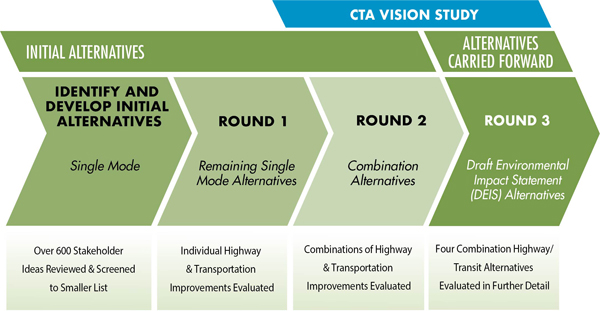
To identify initial alternatives for modeling and evaluation, stakeholder ideas were first categorized by their primary transportation mode and then grouped by similarity. The number of alternatives was further refined based on: feasibility, impacts, performance, cost, and additional stakeholder input.
The alternatives evaluation process included the examination of all modes of travel within the transportation system and included coordination with area transportation agencies (i.e. RTA, CTA, etc.), and their needs in the corridor. The three evaluation rounds can be summarized as follows:
- Round 1 - The identification and evaluation of single-mode alternatives, which are alternatives that consider changes to or improvements of only one mode of transportation, to understand the performance benefits of improvements to individual modes as to how well they addressed the Purpose & Need.
- Round 2 - Based on the results of the Round 1 Single-Mode Evaluation, an initial set of combination mode alternatives were assembled for evaluation in Round 2. Combination-mode alternatives include improvements to, or additions of, more than one mode of transportation (e.g. transit and expressway improvements). In Round 2, the alternatives performance was evaluated as to how well they addressed the identified purpose and need. Top performing alternatives were then considered for further refinement and evaluation in Round 3.
- Round 3 - The top performing Round 2 Combination Mode alternatives were carried forward for further refinement and evaluation in Round 3. Round 3 added design details and incorporated additional analysis including additional travel benefits, environmental effects, construction staging costs, and funding. At the end of Round 3, a smaller set of alternatives were further refined and evaluated in the Draft Environmental Impact Statement will be identified.
The results of the alternatives development and evaluation are available in the Initial Alternatives and Identification Report, which is available on this website.
The Study Team evaluated alternatives based on technical studies and stakeholder input received throughout the I-290 study. Stakeholders were engaged continuously throughout the study process and regularly provided comments and feedback, via one-on-one meetings, town hall meetings, the project website, and public meetings.
Under the provisions of NEPA, multiple alternatives, including the "No Action" alternative, were examined during this process, initial impacts to the surrounding communities were evaluated and key environmental factors identified.
Preferred Alternative
The Round 3 finalist alternatives identified in the Alternatives Development and Evaluation phase underwent more detailed engineering and environmental analysis to evaluate environmental impacts and further refine how well they addressed the I-290 study's identified needs. The environmental analysis included assessing the natural, built, and human environment to determine the extent of impacts that may arise from implementing the improvement. Environmental factors including air quality, noise, socioeconomic impacts, environmental justice, and cultural resources were assessed.
These findings, in addition to the findings from previous steps, were reported in the Environmental Impact Statement. The Preferred Alternative phase concluded with a recommendation of a Preferred Alternative.