skip navigation
  did you know...

Eisenhower Expressway -290 Togethersign up now

to receive project updates, newsletters & alerts via email.

Where Are We Now?

The Illinois Department of Transportation (IDOT) is initiating the Eisenhower Expressway (I-290) Preliminary Engineering and Environmental Study (Phase I).  This study will be developed based upon taking a fresh look at transportation needs through an extensive public involvement process. 

Although some research and solutions have been identified in the past, much has changed, such as traffic and change in travel patterns.  This Phase I study is taking an updated look at the formal analysis of transportation needs.  Depending on the findings of the needs analysis, additional studies, such as the identification of alternatives to address those needs, and an analysis of engineering and environmental impacts, may follow over the next three years.

The study will follow the National Environmental Policy Act (NEPA) process and will involve the preparation of an Environmental Impact Statement (EIS), which is expected to take approximately three years to complete. NEPA is a federal law that requires federally funded projects to evaluate a range of alternatives - including doing nothing, known as “No Build” - and asses the impacts of those alternatives on the environment.  It also requires agencies proposing a project to consider input from the public before making a final recommendation.

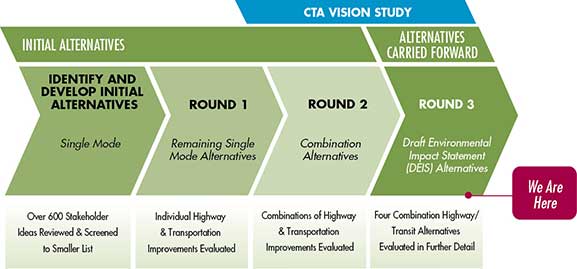
Phase I Study Process

View an enlarged version of the Phase I Study Process graphic [pdf / 90 kb]

Analyzing Existing and Future Conditions and Defining Purpose and Need

The first step of the Phase I Study is to analyze and understand the existing and future travel conditions, and define the Purpose and Need for improvements.  Step 1 tasks include collecting information on current conditions, identifying future population and employment growth in the area, then estimating future travel demand.  This data will help to evaluate the performance of the existing transportation system under future conditions.  All this information will allow IDOT and stakeholders to identify transportation deficiencies and begin the process for developing solutions to address these needs.  Following the data collection and analysis phase, the study will proceed with the development of the specific Purpose and Need that will guide the identification and evaluation of improvement alternatives.

Why Study the “IKE”?

Changing Population, Employment and Travel Patterns

Since the 1950’s, travel demands have increased and changed due to population shifts and growth.  Northeastern Illinois (Chicago and its surrounding counties: Cook, DuPage, Lake, Kane, McHenry and Will) had the highest growth of any counties in Illinois, accounting for 84% of the state’s growth during the 1990s.  Chicago’s share of the region’s population declined over the past few decades.   However, suburban Cook County increased its population, with a greater increase in DuPage County (15.7%) and in Kane County (27.3%), and thus the suburbs together would equal the fourth largest metropolitan area in the nation.  It is estimated that between years 2000 and 2030 the region’s population will grow by 1.8 million people, which is significantly faster than previous decades. This will drive the need for improved transportation.

Congestion and travel delays have been growing in Northeastern Illinois.

  • The Chicago metropolitan region ranks third in Travel Time Index, the ratio of peak period travel to free-flow travel time, behind Los Angeles and San Francisco.
  • The region also ranks third in total annual person hours of delay, behind Los Angeles and New York.
  • The region ranks third in annual total cost due to congestion, behind New York and Los Angeles.
  • Daily vehicle miles traveled on the region’s expressways increased nearly 27% between the years 1990 and 2001.